
The Foundation of Love: Creating Secure Attachment with Your Child
It is impossible to “spoil” a newborn. Quite the contrary, newborns require consistent and predictable responses to their needs to develop and grow. Nature programs us to love and want to protect our children, but developing a secure attachment takes a little more than nature alone. Developing this crucial bond with your baby is an ongoing process throughout their infancy and childhood.
As you both grow and learn together, you will begin to understand their cues and cries and what is needed to respond appropriately. Be patient with yourself and your partner. You are your child’s first teacher, and as you develop this special connection, you are laying the foundation for them to develop empathy, love, understanding, and patience.
What is Secure Attachment?
Secure attachment is a strong, emotional bond your baby feels with you and other caregivers; it is their first form of trust. Human infants, unlike many other species, are wholly dependent on their parents (or caregivers) to care for them and meet their needs. Responding to your newborn’s cries of hunger, sleepiness, or a wet diaper develops that sense of trust and creates a secure attachment.
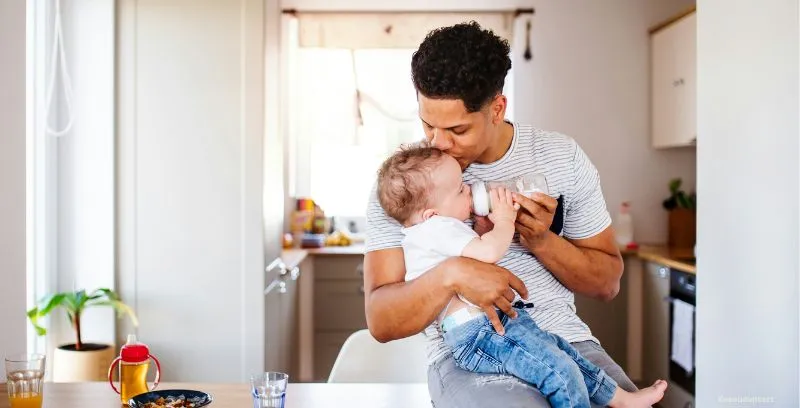
Infants and children develop secure attachment with different adults over time. Parents and primary givers, however, are their first and most essential bond! Your initial bond with your baby lays the foundation for their emotional regulation, social skills, and cognitive skills, which will help them form healthy relationships with others as they grow.
Signs of Secure Attachment in Infants and Toddlers
If you are responding to your baby’s needs, taking care of them, and providing them with lots of hugs and cuddles, you are already doing most of what is needed to develop a secure attachment. However, there are signs you can look for that ensure your little one feels safe and loved.
Signs in Infants
- Turning to their caregiver when they need or want something
- Seeking comfort from their caregiver when distressed
- Showing confidence that their caregiver will meet their needs
- Returning quickly to play or engagement once their need is met
- Able to handle periods of separation from their caregiver
Signs in Toddlers
Toddlers will show the same signs as infants, but because they are now mobile and verbal, there are additional signs.
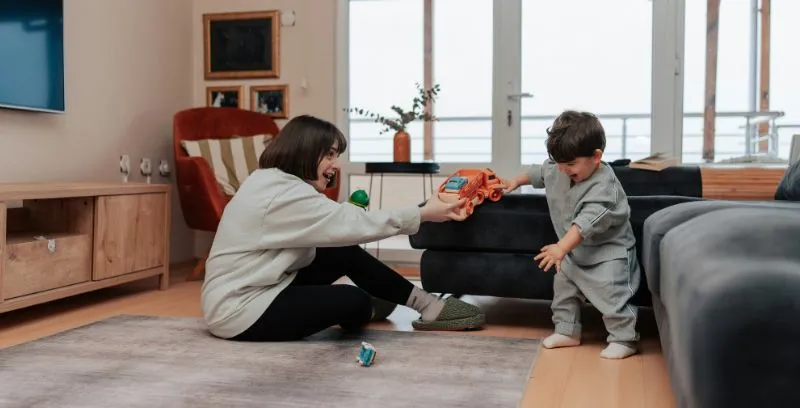
- Feeling comfortable to explore by crawling or walking, but return or reference you for a check-in
- Engaging in longer periods of play
- “Talking” to their caregiver and referencing them for help
- Feeling comfortable around peers
- Feeling comfortable expressing emotions
- Gesturing for physical touch
How to Develop Secure Attachment with Your Child
Developing secure attachment with your child doesn’t mean perfect parenting; there is no such thing. Secure attachment forms naturally when a child experiences repeated, consistent responses to their needs.
So what do repeated and consistent responses to a child’s needs look like? Well, that depends on the child, the situation, and the need, but it may look something like the chart below.
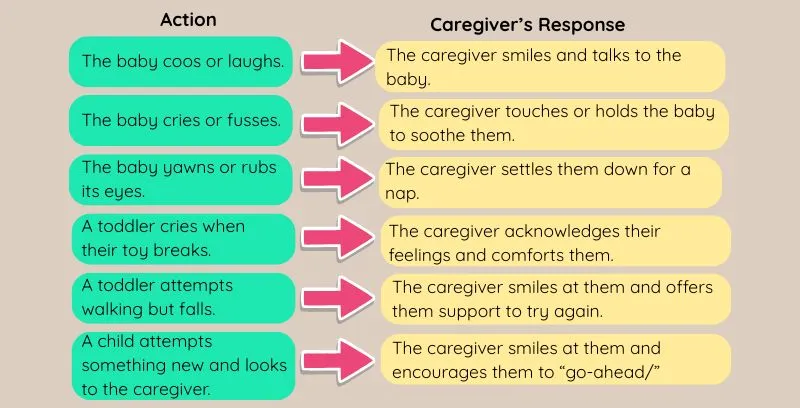
The chart above is only a few examples of ways caregivers can respond to a child’s needs. Keep the following in mind when focusing on developing secure attachment with your baby or toddler:
- Validate their feelings
- Respond in a timely and appropriate manner
- Encourage exploration and trying new things
- Avoid micromanaging or telling them “how” to do something
- Use positive, supportive communication
- Be attentive, avoid distractions
- Establish age-appropriate boundaries
Developing a secure attachment also means taking care of yourself. When parents and caregivers are well-rested, relaxed, and in a positive mindframe, it is easier to respond to a fussy baby or child and to engage in meaningful interactions.

Caregivers should avoid being on their phone or watching TV while trying to build a meaningful bond with their baby. Save those activities for your “adult” or alone time if possible.
Of course, you cannot always avoid distractions, but make sure you set aside special time each day to talk, sing, and play with your baby in a low-distraction zone. Making special time for your child is especially important if you have more than one. Working on secure attachment doesn’t disappear when your child is no longer a baby. Kids of all ages (especially teens) need to continue to feel safe and cared for.
Benefits of Secure Attachment
Psychologists will tell you of the numerous benefits of developing a secure attachment with your baby; there are benefits for both you and your little one! Children who have developed a secure attachment with their parents and primary caregivers have
- More confidence
- Better social skills
- Stronger emotional regulation
- Less stress
- More developed cognitive skills
- Better health

Children with secure attachment tend to explore their environment with confidence, referencing their caregiver as a home base. Exploration develops core cognitive skills like problem-solving and executive functioning. As a result, secure children learn more easily because they can focus on learning rather than constantly monitoring for danger.
And these benefits extend into their teen and adult years. When you develop and maintain a secure attachment with your child, you give them the building blocks they need to form healthy friendships and relationships, build trust in others, handle conflicts, and maintain personal balance and boundaries.
Fostering a secure attachment with your baby is a vital, ongoing journey that lays the groundwork for their emotional, social, and cognitive development. By consistently responding to your child's needs with love and understanding, you nurture their ability to trust and explore the world confidently. Remember, perfect parenting isn't the goal; rather, it's about being present, attentive, and supportive. As you cultivate this bond, you're not only enhancing your child's well-being but also enriching your relationship with them, providing a strong foundation for their future interactions and personal growth.
Related posts

12 Top-Notch Music Books for Kids


Five Easy Ideas for Happy Parents and Happy Kids

10 Magical Christmas and Holiday Apps for Parents
8 Hanukkah Activities for Toddlers and Preschoolers

L. Elizabeth Forry
L. Elizabeth Forry is an Early Childhood Educator with fifteen years of classroom teaching experience. She earned a Master of Science in Early Childhood Education from The University of North Dakota and has a Bachelor of Arts in English and one in Music from Lebanon Valley College. She has taught children in Japan, Washington D.C., Chicago, and suburban Maryland. She is trained as a reading therapist, has a TEFL certification, and has done extensive work with children regarding mental health, social-emotional development, gender development. She has written curriculum for children and educators and has led training sessions for parents and educators on various topics on early childhood development. She is the mother of two boys and resides outside of Annapolis, Maryland.
Related posts
12 Top-Notch Music Books for Kids
Five Easy Ideas for Happy Parents and Happy Kids
10 Magical Christmas and Holiday Apps for Parents